The Secret Powers of Ovulation—It’s Not Just to Make a Baby

The ovarian hormones estradiol and progesterone are highly beneficial for general health, and the only way to make them is with regular ovulation.
The Pros and Cons of Copper IUDs (ParaGard or Miudella)

Copper IUDs or coils (ParaGard or the new Miudella) are non-hormonal methods of birth control.
The main advantage of a copper IUD over hormonal methods is that it contains no contraceptive medication and therefore permits natural ovulatory menstrual cycles.
Of course, it also has some downsides.
Do Women Need Periods?

With the 2019 news that women don’t need pill bleeds came the assurance that “women don’t need periods.” But is that accurate?
It’s true that women don’t need monthly pill withdrawal bleeds because they’re not periods, but women do need (or at least benefit from) monthly natural menstrual cycles because that’s how we make the hormones estradiol and progesterone.
Which Types of Birth Control Cause Weight Gain?
Hormonal birth control can negatively affect metabolic health and contribute to weight gain. Some types are more likely to do so than others, depending on the type of progestin.
But before we get to the question of “which progestin,” I’ll just point out that the biggest problem with hormonal birth control is that it (usually) switches off hormones.
How Science Got It Wrong About Progesterone
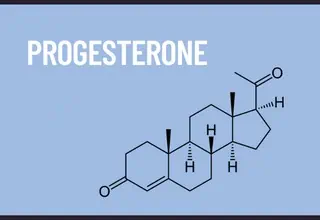
Progesterone is important for women’s health. Yet for decades, it has been ignored or wrongly blamed for side effects it doesn’t cause. How did that happen?
A missed opportunity
Progesterone was discovered shortly after estrogen, missing the chance to be included in the simplified narrative of “testosterone for men and estrogen for women.” To complicate things further, progesterone couldn’t initially be made into an oral medication, so it was sidelined in favor of synthetic progestins.
Pain Is Not a Symptom of PCOS
According to a 2017 study, pain is the most frequently reported symptom of PCOS, even though pain is not a symptom of PCOS.
The solution to this paradox is that both PCOS and period pain are common, so it’s easy to have both a PCOS diagnosis and pelvic pain. But, importantly, the PCOS diagnosis can only explain irregular periods or symptoms of androgen excess (e.g., facial hair). It can’t explain the pain!
Also, PCOS cannot be diagnosed by ultrasound.