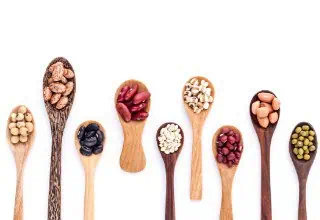
Phytoestrogens are a special group of phytonutrients that occur naturally in most plant foods. The two major classes are isoflavones in soy and lignans in seeds, whole grains, legumes, fruits, and vegetables.
They’re called phytoestrogens because they interact with estrogen receptors, but they’re not estrogen. In fact, they bind so weakly to estrogen receptors that they effectively block estradiol and are more accurately characterized as anti-estrogen.
For example, it’s long been observed that phytoestrogen crops such as red clover suppress the estrogen and fertility of livestock. It’s even been proposed that plants evolved phytoestrogens to reduce the fertility of female herbivores and prevent overgrazing.
In a chapter called “Agriculture and Selection for High Levels of Estrogen,” evolutionary biologist Grazyna Jasienska argues that humans evolved a higher level of estrogen to cope with the anti-estrogen effects of grains, legumes, and seeds. In other words, it’s fine to eat phytoestrogens like legumes and seeds because they’re part of our traditional diet, and our hormonal system is calibrated to them.
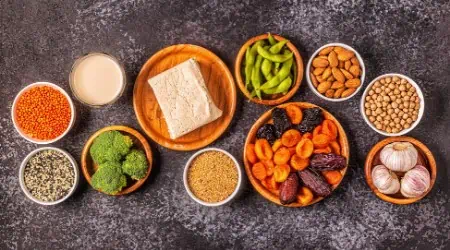
How phytoestrogens can benefit women’s health and hormones
For women of reproductive age, phytoestrogens have a beneficial anti-estrogen effect and help to promote the healthy metabolism or detoxification of estrogen. Food-based phytoestrogens may even reduce the risk of some hormone-sensitive cancers.
Heavy periods. In general, phytoestrogens make periods lighter, but very high doses can cause heavier periods if they suppress ovulation and progesterone. That’s why (in part) a vegan or exclusively plant-based diet can cause period problems.
Endometriosis. Phytoestrogens are generally beneficial for endometriosis, but plant foods high in salicylates could cause a negative immune or mast-cell reaction. Read Immune treatment for endometriosis.
PCOS. By improving insulin sensitivity, isoflavones can have a beneficial effect on polycystic ovary syndrome.
Hypothalamic amenorrhea. Phytoestrogens cannot boost estrogen or correct the estrogen deficiency of hypothalamic amenorrhea. The treatment for hypothalamic amenorrhea is to promote ovulation by eating more. Read How to increase estrogen.
Menopause. In menopause, when estrogen is low, phytoestrogens can (in theory) have a beneficial pro-estrogen effect, but according to several large research studies, soy isoflavones don’t do much, if anything, for menopausal symptoms.
Thyroid disease. Concentrated extracts of soy isoflavones may suppress thyroid function. Food-based soy is probably fine as long as you consume enough iodine.
In conclusion, phytoestrogens generally have a beneficial anti-estrogen effect in women of reproductive age. They have a mild pro-estrogen effect in menopausal women, which may be beneficial, and a pro-estrogen (endocrine-disrupting) effect in men and children, which could be a problem at high doses.